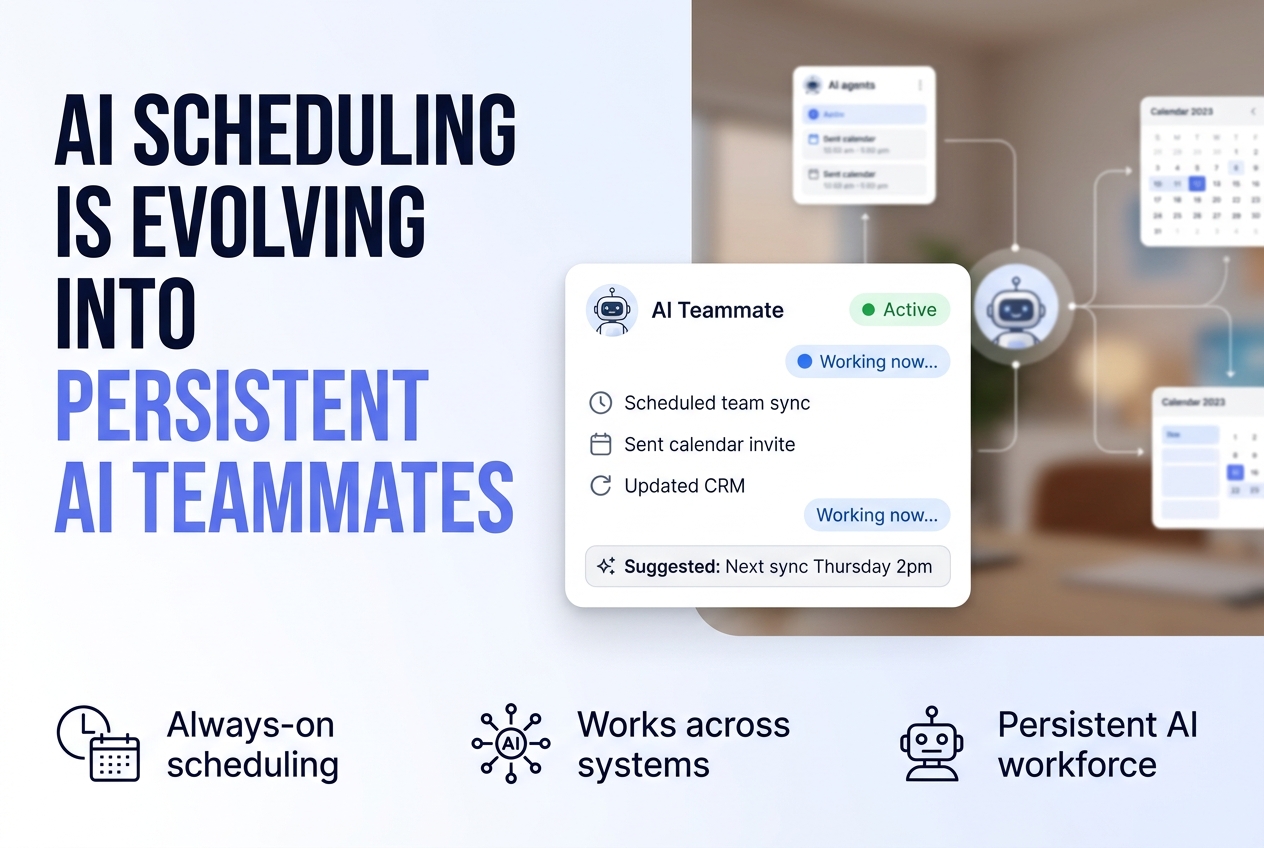
We closely follow technologies that are reshaping how organizations operate, collaborate, and automate work, especially as related to scheduling and calendaring. One of the interesting new platforms we’ve seen is WorkClaw — a cloud-based AI workspace designed to give teams persistent AI assistants that can actively perform operational tasks across business systems.
Built on top of the growing OpenClaw ecosystem, WorkClaw positions itself as more than a chatbot platform. Instead, it provides organizations with customizable AI “workers” that can collaborate through tools such as Slack, Microsoft Teams, email, calendars, CRMs, and shared drives.
According to the company, each WorkClaw instance operates within its own isolated environment and can be configured with custom workflows, memory, instructions, and reusable team skills.
Some of the capabilities highlighted in the platform include:
- Persistent AI assistants operating continuously in the cloud
- Team-wide sharing of reusable AI workflows and “skills”
- Integrated file management and shared-drive awareness
- Customizable agent identities, tone, and operating instructions
- Security-focused controls for enterprise environments
- API-driven automation and deployment support
At the moment, WorkClaw is operating with a limited-access rollout model. You can join the company’s “Early Access” program, although current onboarding appears to involve a 5–7 day waiting period before accounts are activated.
Another interesting aspect of the company is the presence of Ammon Brown, whose title at WorkClaw is “Head of Clawstomer Aclawsition.” Prior to joining WorkClaw, Brown was associated with the original x.ai — one of the earlier AI assistant startups focused on autonomous scheduling.
The original x.ai became widely known for its AI-powered meeting assistants “Amy” and “Andrew,” which allowed users to simply CC an AI assistant into email threads. The system could then autonomously coordinate meeting times, negotiate schedules across participants, handle time-zone conversions, send reminders and follow-ups, and process cancellations without requiring manual intervention.
As AI agents continue evolving beyond simple conversational interfaces, platforms like WorkClaw represent a broader shift toward AI-enabled operational infrastructure — where software can actively participate in workflows rather than simply respond to prompts.
