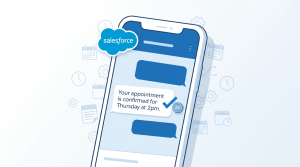
Salesforce just launched a prebuilt AI agent that handles scheduling inside the conversation. The pricing model is genuinely novel. The underlying technology may not be.

Appointment scheduling is quietly making a comeback in the U.S. government’s visa operations — but this time, it’ll cost you. The State Department is set to launch a pilot program that allows foreign nationals seeking…
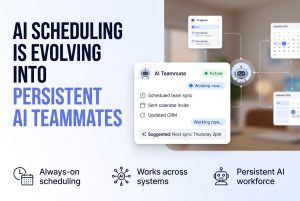
We closely follow technologies that are reshaping how organizations operate, collaborate, and automate work, especially as related to scheduling and calendaring. One of the interesting new platforms we’ve seen is WorkClaw — a cloud-based AI…
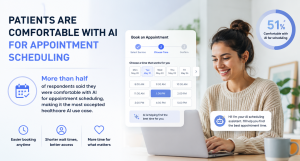
A new AMA report highlights a growing divide in healthcare AI adoption: physicians are increasingly embracing AI tools, while patients remain cautious when AI moves deeper into clinical care. But buried inside the findings is…
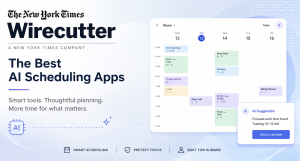
The New York Times Wirecutter article “best AI scheduling apps” highlights a growing divide in productivity software: fully automated AI schedulers versus more “thoughtful” planning tools that keep humans in control. Although many AI scheduling…
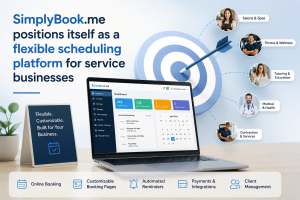
According to a recent overview published by Goodcall, SimplyBook.me continues to position itself as a highly customizable alternative to mainstream scheduling tools such as Calendly and Acuity Scheduling. The platform emphasizes online booking management, automated…
- Persistent AI assistants operating continuously in the cloud
- Team-wide sharing of reusable AI workflows and “skills”
- Integrated file management and shared-drive awareness
- Customizable agent identities, tone, and operating instructions
- Security-focused controls for enterprise environments
- API-driven automation and deployment support
The TASBIA™ Bottom Line
Appointment scheduling represents one of the few AI use cases where providers, administrators, and patients all appear aligned around the benefits. Unlike clinical AI, scheduling automation is easy to understand, low risk, and immediately visible to patients through shorter wait times, easier booking, and better communication. The healthcare industry may ultimately adopt sophisticated clinical AI systems at scale. But patient acceptance is likely to happen incrementally — beginning with the operational workflows people already dislike. And right now, scheduling appears to be leading the way. [post_title] => Patients Are Comfortable With AI Scheduling — And That’s a Bigger Deal Than It Sounds [post_excerpt] => [post_status] => publish [comment_status] => closed [ping_status] => closed [post_password] => [post_name] => patients-are-comfortable-with-ai-scheduling-and-thats-a-bigger-deal-than-it-sounds [to_ping] => [pinged] => [post_modified] => 2026-05-24 09:25:44 [post_modified_gmt] => 2026-05-24 13:25:44 [post_content_filtered] => [post_parent] => 0 [guid] => https://tasbia.com/?p=2917 [menu_order] => 0 [post_type] => post [post_mime_type] => [comment_count] => 0 [filter] => raw ) [4] => WP_Post Object ( [ID] => 2899 [post_author] => 2 [post_date] => 2026-05-18 08:04:26 [post_date_gmt] => 2026-05-18 12:04:26 [post_content] => The New York Times Wirecutter article “best AI scheduling apps” highlights a growing divide in productivity software: fully automated AI schedulers versus more “thoughtful” planning tools that keep humans in control. Although many AI scheduling apps promise to optimize calendars automatically, the best experiences often come from products that balance automation with intentional daily planning. Among the products evaluated, Sunsama emerged as a standout for its lighter-touch approach to AI. Rather than aggressively rearranging users’ calendars, Sunsama focuses on guided daily planning, unified task management, and gentle AI assistance such as estimating task durations and suggesting schedule placement. Wirecutter reviewers noted that the platform “uses just a dash of AI” and praised its emphasis on helping users think deliberately about priorities rather than surrendering their schedules entirely to automation. The article contrasted Sunsama with more automation-heavy competitors such as Motion and Reclaim.ai. Motion was recognized for sophisticated automatic rescheduling and task optimization, but reviewers described the experience as complex and sometimes overwhelming in day-to-day use. Reclaim.ai earned praise for protecting focus time and automatically shifting calendar blocks as schedules change, making it especially attractive for hybrid work environments. A recurring theme is that users increasingly want AI scheduling systems that reduce friction without becoming intrusive. Community discussions and independent reviews repeatedly point to frustration with bloated interfaces, excessive automation, and tools that require too much manual correction after the AI makes scheduling decisions. Many users appear to prefer products that simplify workflows while still leaving room for human judgment. The broader takeaway for the scheduling software market is that “AI-powered” alone is no longer enough. The products gaining traction are those that combine automation with usability, flexibility, and trust — helping users feel more organized without making them feel managed by the software itself. [post_title] => Why the Best AI Scheduling Apps Are Moving Beyond Full Automation [post_excerpt] => [post_status] => publish [comment_status] => closed [ping_status] => closed [post_password] => [post_name] => why-the-best-ai-scheduling-apps-are-moving-beyond-full-automation [to_ping] => [pinged] => [post_modified] => 2026-05-24 08:13:57 [post_modified_gmt] => 2026-05-24 12:13:57 [post_content_filtered] => [post_parent] => 0 [guid] => https://tasbia.com/?p=2899 [menu_order] => 0 [post_type] => post [post_mime_type] => [comment_count] => 0 [filter] => raw ) [5] => WP_Post Object ( [ID] => 2902 [post_author] => 2 [post_date] => 2026-05-15 08:22:16 [post_date_gmt] => 2026-05-15 12:22:16 [post_content] => According to a recent overview published by Goodcall, SimplyBook.me continues to position itself as a highly customizable alternative to mainstream scheduling tools such as Calendly and Acuity Scheduling. The platform emphasizes online booking management, automated reminders, payment processing, client management, and integrations with systems such as Google Calendar, Zoom, Stripe, PayPal, Mailchimp, and WordPress. The company appears to be targeting a broad range of appointment-driven industries including salons, spas, fitness centers, tutoring services, medical clinics, contractors, and repair businesses. The platform’s multi-language support and customizable booking pages have also helped it gain traction internationally. Industry reviews suggest that SimplyBook.me’s differentiation strategy centers on flexibility rather than simplicity. A review from Forbes Advisor noted the platform offers more than 60 optional “custom features,” including HIPAA-related security options, loyalty programs, coupons, gift cards, and client apps. However, reviewers also noted that the large feature set can create a steeper learning curve compared to lighter-weight scheduling products. The Goodcall article also highlights a growing trend in the appointment scheduling sector: the integration of AI-driven customer interaction tools directly into scheduling workflows. Goodcall positions its AI phone assistant as a complement to SimplyBook.me, enabling automated appointment scheduling, rescheduling, and customer support interactions without human intervention. This broader convergence between scheduling and AI-enabled customer engagement has accelerated across the industry over the past year. Companies such as Capacity have expanded aggressively into scheduling automation, including its recent acquisition of YouCanBookMe to strengthen multi-calendar booking and workflow automation capabilities (see Capacity announces the acquisition of YouCanBookMe article). As AI increasingly becomes embedded into booking, communication, and customer service systems, platforms like SimplyBook.me may face pressure to evolve beyond traditional appointment management toward more autonomous customer interaction models. At the same time, its strong customization capabilities and broad vertical support may help it remain attractive to businesses seeking greater control over branded booking experiences. [post_title] => SimplyBook.me positions itself as a flexible scheduling platform for service businesses [post_excerpt] => [post_status] => publish [comment_status] => closed [ping_status] => closed [post_password] => [post_name] => simplybook-me-positions-itself-as-a-flexible-scheduling-platform-for-service-businesses [to_ping] => [pinged] => [post_modified] => 2026-05-24 08:38:18 [post_modified_gmt] => 2026-05-24 12:38:18 [post_content_filtered] => [post_parent] => 0 [guid] => https://tasbia.com/?p=2902 [menu_order] => 0 [post_type] => post [post_mime_type] => [comment_count] => 0 [filter] => raw ) ) [post_count] => 6 [current_post] => -1 [before_loop] => [in_the_loop] => [post] => WP_Post Object ( [ID] => 2928 [post_author] => 2 [post_date] => 2026-06-26 09:22:48 [post_date_gmt] => 2026-06-26 13:22:48 [post_content] =>Salesforce this week announced Help Agent, a prepackaged AI customer service agent built on its Agentforce platform. The pitch is simple: companies can spin up an agent in minutes, connect it to their knowledge base and communication channels — web, text, or voice — and let it handle customer service autonomously from day one.
For anyone tracking the intersection of AI and appointment scheduling, one detail in the announcement stands out above everything else: customers can now complete tasks — including booking an appointment — entirely within the conversation flow, without ever leaving the chat, picking up the phone, or clicking through to a separate scheduling portal.
That’s not a small thing. The experience of having to abandon a conversation to go schedule something — or being transferred to a human who then has to look up a calendar — is one of the most persistent friction points in service operations. The new Customer Service Portal at the center of Help Agent is specifically redesigned around this: when a customer describes what they need, the portal responds with dynamic AI-generated cards that let them act on the spot.
“Now, when customers describe what they need, the portal adapts by delivering personalized responses and dynamic AI-generated cards that enable users to complete tasks within the conversation flow.”
— Salesforce Help Agent announcement, June 2026
Appointment scheduling is listed explicitly alongside order management and account management as one of the “additional actions” that can be connected to the agent through Agentforce Builder. That makes Help Agent one of the more direct deployments of in-conversation scheduling from a tier-one enterprise platform we’ve seen to date.
What’s Actually Powering the Scheduling
Under the hood, Salesforce’s scheduling capability in Agentforce runs on Salesforce Scheduler, the company’s native appointment and resource booking engine. Scheduler has been part of the Salesforce platform for several years and enables organizations to manage time slots, service resources, territories, and booking rules from within the CRM.
The catch: Salesforce Scheduler is a paid add-on. It is not included in standard Service Cloud or Sales Cloud licenses. Organizations that want to enable the appointment scheduling action within Help Agent will need to have — or purchase — Scheduler as part of their Salesforce footprint.
That also raises a question that Salesforce has not yet addressed publicly: what happens if you’re already using a third-party scheduling solution? The Salesforce AppExchange is home to a range of appointment scheduling and calendar management applications — tools like Engageware, various Calendly connectors, and a range of industry-specific booking apps. Whether Help Agent’s in-conversation scheduling actions can connect to those third-party tools, or whether the feature is effectively limited to organizations running native Salesforce Scheduler, is not clear from the current documentation or announcement materials.
For Salesforce-native shops, this could be a compelling reason to consolidate on Scheduler. For organizations that have invested in a purpose-built third-party scheduling platform — or one with deeper industry-specific functionality — the path forward is murkier.
The $2 Pricing Model Is Novel
Beyond the scheduling capability itself, Salesforce is doing something novel with how its pricing Help Agent. Rather than charging by token, by API call, by minute of voice interaction, or by some proprietary “credit” that customers have to estimate in advance, Salesforce is charging a flat $2 per resolved conversation — and only when the agent fully resolves the issue autonomously, start to finish.
“It’s a flat price of $2 when a resolution is achieved.”
— Prasad Raje, SVP of Product, Agentforce Service
This is outcome-based monetization, and it’s a departure from how AI services have typically been sold. The burden shifts from customer to vendor: Salesforce only earns the $2 if the agent actually did the job. Customers can calculate ROI against the cost of a human-handled support interaction — a number most service operations already know — rather than trying to estimate how many tokens a booking confirmation will consume.
Whether that pricing holds up at scale, and how Salesforce defines “resolution” in edge cases, will be worth watching. But as a positioning move, it’s a smart one. It aligns Salesforce’s incentives with the customer’s: get to a successful outcome, or you don’t get paid.
The Bigger Picture: Scheduling as a Conversation
We’ve written before about how consumers are growing increasingly comfortable with AI handling scheduling tasks. What Salesforce is describing here is the next step in that evolution — not just AI that can answer scheduling questions, but AI that can complete the booking without ever handing the conversation off to a separate workflow.
That in-conversation completion model matters because it closes the loop on what has historically been the weakest moment in AI-assisted service: the handoff. When a chatbot answers your question but then tells you to “click here to schedule,” you’ve effectively broken the experience. Help Agent is designed to eliminate that gap.
Help Agent and the redesigned Customer Service Portal are expected to be generally available in July 2026.
The TASBIA™ Bottom Line
Salesforce’s Help Agent is one of the new many implementations of in-conversation task completion we’ve seen with appointment scheduling explicitly included. The pay-per-resolution model ($2 per successful autonomous resolution) is a good approach to AI pricing that aligns vendor incentives with customer outcomes, and it deserves attention beyond the scheduling space.
That said, the fine print matters. The scheduling capability leans on Salesforce Scheduler, a paid add-on, meaning this isn’t a feature that lights up automatically for every Salesforce customer. More importantly, it’s not yet clear how Help Agent interacts with the ecosystem of third-party scheduling tools — apps like Engageware and others — that many Salesforce customers already rely on via the AppExchange. If you’re a Salesforce shop already running Scheduler natively, this is a compelling path to in-conversation booking. If you’re running a third-party scheduling solution, the question of whether Help Agent can work with it — or whether it requires you to rethink your scheduling stack entirely — is still an open one.
The $2 model is a bet that AI can reliably close the loop on service interactions. Whether scheduling an appointment counts as a “resolution” in Salesforce’s definition — and whether that resolution holds up across the full diversity of real-world booking scenarios — will be the real test.
Sources: SiliconAngle, June 25, 2026 · Salesforce Scheduler Overview
[post_title] => Salesforce’s New Agent Books Appointments for $2 — But Read the Fine Print [post_excerpt] => Salesforce just launched a prebuilt AI agent that handles scheduling inside the conversation. The pricing model is genuinely novel. The underlying technology may not be. [post_status] => publish [comment_status] => closed [ping_status] => closed [post_password] => [post_name] => salesforce-help-agent-books-appointment-2-dollars [to_ping] => [pinged] => [post_modified] => 2026-06-26 09:22:48 [post_modified_gmt] => 2026-06-26 13:22:48 [post_content_filtered] => [post_parent] => 0 [guid] => https://tasbia.com/?p=2928 [menu_order] => 0 [post_type] => post [post_mime_type] => [comment_count] => 0 [filter] => raw ) [comment_count] => 0 [current_comment] => -1 [found_posts] => 115 [max_num_pages] => 20 [max_num_comment_pages] => 0 [is_single] => [is_preview] => [is_page] => 1 [is_archive] => [is_date] => [is_year] => [is_month] => [is_day] => [is_time] => [is_author] => [is_category] => [is_tag] => [is_tax] => [is_search] => [is_feed] => [is_comment_feed] => [is_trackback] => [is_home] => [is_privacy_policy] => [is_404] => [is_embed] => [is_paged] => [is_admin] => [is_attachment] => [is_singular] => [is_robots] => [is_favicon] => [is_sitemap] => [is_posts_page] => [is_post_type_archive] => [query_vars_hash:WP_Query:private] => 2d699070678a2be1b3b013d0404413d0 [query_vars_changed:WP_Query:private] => [thumbnails_cached] => [allow_query_attachment_by_filename:protected] => [stopwords:WP_Query:private] => [compat_fields:WP_Query:private] => Array ( [0] => query_vars_hash [1] => query_vars_changed ) [compat_methods:WP_Query:private] => Array ( [0] => init_query_flags [1] => parse_tax_query ) [query_cache_key:WP_Query:private] => wp_query:38e62a9172c81adcf98892e058e556a8 )